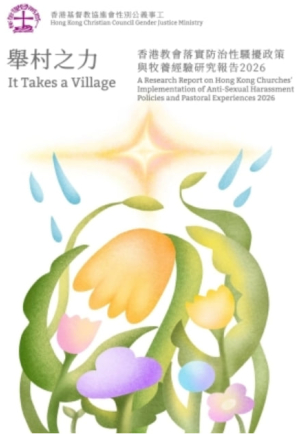
The Gender Justice Ministry of the Hong Kong Christian Council (HKCC) released a landmark report on July 6. Titled “It Takes a Village: A Research Report on Hong Kong Churches’ Implementation of Anti-Sexual Harassment Policies and Pastoral Experiences 2026” (《舉村之力:香港教會落實防治性騷擾政策與牧養經驗研究報告2026》), the study is the city's first to examine this issue from the perspective of multiple stakeholders.
The findings reveal that local churches have significant room for improvement in establishing sexual harassment prevention policies. More than half of the surveyed congregations have not set up such policies or are unsure if they exist. Furthermore, even among churches that have formulated these guidelines, more than half have never actually implemented or utilized them.
The primary objective of the “It Takes a Village” report is to offer concrete, actionable recommendations for Christian communities to effectively prevent and respond to sexual violence within churches.
The report’s launch event, held at the Morrison Memorial Centre of the Hong Kong Council of the Church of Christ in China, drew a large audience of pastors, church leaders, and lay believers. Jessica Tso Hiu-tung (曹曉彤), Executive Secretary of the HKCC, noted that while churches have made progress in addressing sexual harassment since 2015, the data underscores a pressing need for wider promotion. She urged churches to draft explicit policies and conduct regular training to ensure their proper implementation.
Over Half of Churches Lack Policies; Transparency Remains Low
The research team distributed questionnaires to churches across Hong Kong and conducted in-depth interviews, receiving 73 valid responses. The results showed that over half of the responding congregations had no sexual harassment prevention policies, or were unaware if any existed.
Among the churches that did have policies, 76% only established them after the 2018 #MeToo movement and a series of local church scandals. This indicates that reforms have largely been a reactive response to external social pressure rather than proactive initiatives. Furthermore, 66% of the surveyed congregations had never participated in any relevant training. After auditing the websites of 1,154 churches in Hong Kong, the research team found that only 7.3% made their policies publicly accessible, highlighting a severe lack of transparency.
Victims Delay Seeking Help by 10 Years on Average, Fearing Secondary Trauma
The study documented cases from at least 69 victims, 70% of whom were female. Alarmingly, at least three of the victims were between the ages of 13 and 15 at the time of the abuse, and most had known their perpetrators for more than two years.
Tso cited data showing that, on average, victims waited ten years after the abuse before disclosing the incidents publicly. This delay is primarily due to a psychological tendency to avoid the traumatic setting and suppress the memories. She pointed out that when victims finally come forward years later, they are often met with public skepticism, causing secondary trauma to their daily lives and mental well-being.
Tso explained that perpetrators typically exploit the victims’ trust in the church and pastoral figures, gradually blurring personal boundaries before committing acts of sexual violence. She argued that the prevailing church culture—which tends to revere authority and prioritize harmony—inadvertently fosters an environment where perpetrators can operate, bystanders remain silent, and victims are left with nowhere to turn.
Culture of Silence: Scholar Highlights Power Imbalances
Speaking at the launch event, Dr. Wong Wai-ching (黃慧貞), an Adjunct Associate Professor in the Department of Cultural and Religious Studies at the Chinese University of Hong Kong, observed that traditional church culture often associates sexuality with "shame," placing immense moral pressure on victims.
She noted that congregations heavily emphasize obedience, humility, and peace. Consequently, when sexual harassment occurs, there are often internal pressures discouraging victims from pursuing complaints—sometimes even demanding they drop charges on the grounds that the perpetrator has shown repentance. Dr. Wong also pointed out that the boundaries defining violence and harassment remain blurry within churches, which often overlook forms of sexual violence other than rape. She called on churches to honestly confront the deep power imbalances between clergy and lay members.
Demands for Trauma-Informed Care and Independent Third-Party Investigations
Responding to the report, Doris T.W. Chong (莊子慧), Executive Director of the Association Concerning Sexual Violence Against Women, cited RainLily's retrospective study covering 2019 to 2023. The data showed that sexual violence victims in Hong Kong delay seeking help by an average of 12.8 years, with many cases occurring during childhood and only being reported to the police after years. Over the past five years, RainLily has recorded 14 cases where the accused perpetrators were pastors or individuals associated with religious organizations.
Chong emphasized that survivors often continue to attend the same church or coexist with their abusers, a behavior that the public struggles to understand. She stressed the necessity of understanding the real psychological state of these victims. Within the specific atmosphere of a church, survivors often remain silent due to shame, the religious authority of the perpetrator, or the fear of not being believed. Chong also criticized certain "spiritual healing" practices used by some churches, such as "body cleansing" rituals, which she warned can cause secondary trauma to survivors. She urged the religious sector to address these systemic loopholes.
To address the current situation, the report offers several recommendations, including urging churches to formulate concrete policies, provide regular training, and cultivate a "trauma-informed" culture that enables handlers to understand the psychological trauma experienced by victims. Furthermore, the report advocates for the introduction of an independent third-party mechanism and a talent pool so that external professionals can conduct independent investigations when complaints arise, thereby mitigating an individual congregation's lack of experience or potential bias stemming from close-knit networks of acquaintances.
In addition to the research findings, the HKCC has published the Practical Handbook on Sexual Harassment Prevention for Hong Kong Churches for pastors, church leaders, and ministry heads. The council plans to host a series of seminars and training sessions on preventing sexual violence tailored for church staff, leaders, and children's ministry workers.
(Summary Report)