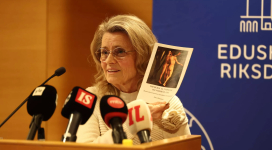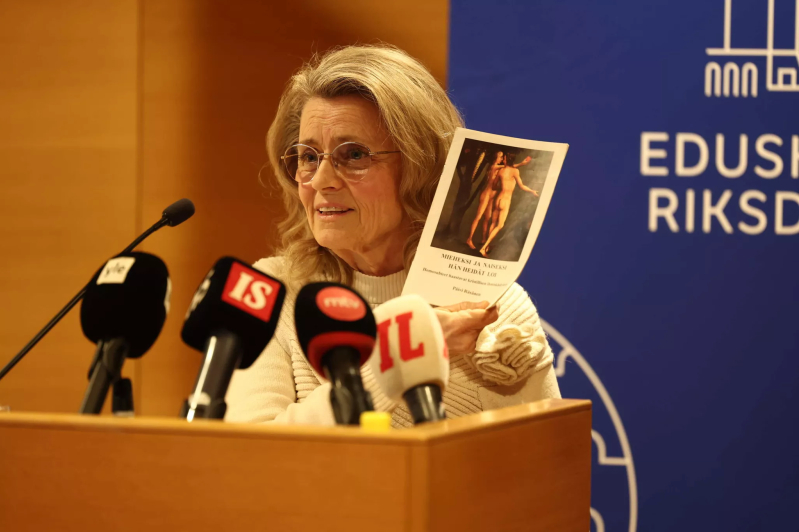
Finnish Member of Parliament and practicing physician Päivi Räsänen was convicted on March 26 of incitement against an ethnic group, following a split 3–2 court decision. The charge stemmed from a booklet she authored more than two decades ago, in which she described homosexuality as a “psychosexual developmental disorder.”
Räsänen was fined 1,800 euros (approximately $2,080) and ordered to destroy all physical and digital copies of the publication.
The case originated from a criminal complaint filed after Räsänen criticized the Evangelical Lutheran Church of Finland in a 2019 tweet for supporting LGBT Pride Month. In the post, she quoted Romans 1:24–27, questioning the church’s celebration of what she termed “shame and sin.”
Investigators later expanded their probe to include a booklet she published in 2004, titled “Male and Female He Created Them: Homosexual Relationships Challenge the Christian Concept of Humanity.” The text argued that homosexuality represents a form of disorder.
While Finland’s Supreme Court acquitted Räsänen over the 2019 tweet—noting she had “based her views on biblical texts”—it found her 2004 booklet violated Chapter 11 of the country’s Penal Code. The court ruled that the content insulted homosexuals as a group based on their sexual orientation, constituting unlawful hate speech.
The Washington Post editorial board condemned the ruling, warning that it threatens free speech beyond Scandinavia. In an editorial, the paper stated that prosecuting Räsänen was the “real crime,” emphasizing that a culture protecting expression is as vital as constitutional guarantees.
“Courts should not be arbiters of which opinions are acceptable, particularly when those opinions belong to a minority,” the editorial read. “The court acknowledged her writing did not incite violence, yet still found her guilty.”
Paul Coleman, Executive Director of ADF International, which legally supports Räsänen, called the verdict a “shocking example of state censorship.” He noted that the law under which she was convicted did not exist when the booklet was written.
Coleman warned of a “severe chilling effect” on free speech in Finland and across Europe. In a 2024 statement, he compared the case to a modern-day “heresy trial,” arguing that “in a Western democracy, no one should face trial for their beliefs.”
Räsänen expressed shock and profound disappointment at the Supreme Court’s decision, stating that it disregarded her fundamental right to freedom of expression.
“I uphold the teachings of my Christian faith and will continue to defend everyone’s right to express their convictions publicly,” she said.
She is considering an appeal to the European Court of Human Rights, asserting that the outcome will affect not only her case but also the rights of all Finns. “A favorable ruling would help prevent others from being persecuted for expressing their beliefs,” she added.
In a related case, Juhana Pohjola, dean of the Evangelical Lutheran Mission Diocese of Finland, was investigated in 2020 for distributing Räsänen’s booklet and charged with incitement to racism.
Sources: Christian Post, ADF International, The Washington Post, Finnish Supreme Court