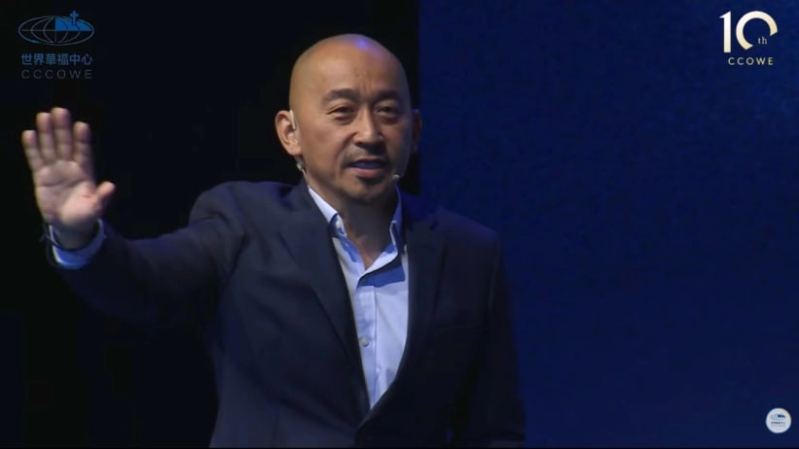
Speaking on the morning of July 22 at the 10th Chinese Congress on World Evangelization (CCOWE) in Kuching, Malaysia, Rev. Wayne Chen, General Director of the Radius Asia Mission Training Center, delivered a keynote message titled "Holistic Mission." Addressing global Chinese church leaders, Chen challenged the pervasive dichotomy between "soul-saving evangelism" and "social concern," asking attendees to consider, "How grand is the Gospel, after all?"
Chen noted that modern discourse often defaults to binary thinking: "When we say the Church's supreme mission is to proclaim the Gospel and save souls, some counter by asking why we ignore societal needs. Yet when we advocate for social participation, others accuse us of neglecting the Gospel of the Cross."
When 'Everything Is Mission,' the Church Loses Direction
Chen observed that Chinese-speaking churches are frequently reminded that they "must not become detached from the world." However, he pointed out two traps facing the contemporary Church: "When every good deed a Christian performs is labeled a 'mission'—when social care is a mission, environmental protection is a mission, education is a mission, cultural transformation is a mission, social-enterprise impact is a mission, and helping vulnerable groups is a mission—we fall into a ditch where doing one less thing makes us feel 'unholistic.'"
A more severe crisis, Chen warned, is the loss of focus. "If everything is classified as a mission, we ultimately lose our direction because the Church loses sight of the unique task God entrusted specifically to it."
Local church pastors often struggle with limited time and resources. Without a clear direction under such constraints, churches risk being dragged around by every visible need rather than being guided by the Gospel's trajectory.
Illustrating his point, Chen compared the Church to a hospital. A modern hospital might feature pianos, reading rooms, and gardens to make patients feel respected and seen, but its sole unique mission remains treating illness. Addressing the Church solemnly, Chen said: "We ought to care for societal needs. But what God has entrusted to the Church—and to no other institution—is proclaiming the Gospel of reconciliation with God and making disciples of Christ. When we lose this core, we can remain extremely busy, exert influence, and even win the world's praise, but we risk forgetting why God established the Church in the first place."
Social Care Is the Fruit of the Gospel—Not the Gospel Itself
Chen clarified that he was not pitting "evangelism" against "social engagement," acknowledging that Jesus constantly served the vulnerable and marginalized, and that the Church must care for the world's needs. However, he introduced a crucial distinction: "Social care is the fruit born from the Gospel, but social care itself is not the Gospel."
Poverty alleviation is not the Gospel in itself, nor is medical ministry the Gospel itself—even though genuine Gospel transformation should yield these fruits. Rather, the core message God entrusted to the Church is the soul-saving Gospel: "The core of the Gospel entrusted to us is that through Jesus Christ—who is both King and Savior—God reconciles sinners to Himself."
Chen observed that many churches follow needs—reacting to social injustice, orphans, widows, or human trafficking. Yet Jesus walked with a clear direction, and the Apostle Paul's missionary strategy centered squarely on unreached peoples. "This is not indifference toward social needs, but a directionality centered on the Gospel. When Paul asked where Christ had not yet been named, he was reminding the Church of our irreplaceable mission: if we do not preach the Gospel, no one else will."
NGOs can alleviate poverty, governments can provide social welfare, schools can offer education, and corporations can drive social impact, Chen noted. But only the Church is commissioned to proclaim Christ and raise up His disciples.
A PNG Youth Sees Urgency Beyond This Life
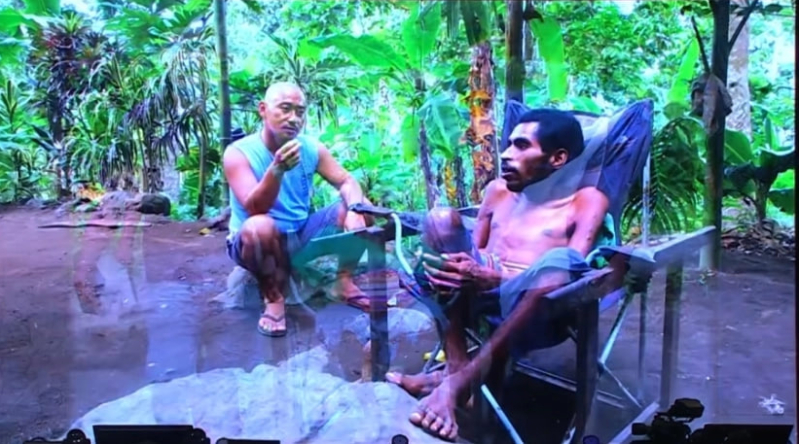
Reflecting on his time serving a remote tribe in Papua New Guinea (PNG)—where he provided medical and health services in an environment lacking electricity, water, and internet—Chen shared a story about his deep friendship with a local youth named Bagat.
One night, while fishing by the sea, their hook got snagged on a rock, forcing them to return empty-handed. Early the next morning, Bagat swam out into the ocean to retrieve the hook and returned it to Chen. "I was deeply shaken," Chen recalled. "I had hundreds of hooks back home. But to him, a single hook was vital because without it, they couldn't catch fish, and without fish, they had no food. At that moment, I realized we lived in two entirely different worlds."
Bagat later became one of the first Christians and church leaders in the tribe. Years later, however, he contracted a rare neurological disease and gradually lost his mobility. During the final stage of his life, Bagat made a last request to the church during a Sunday service: "I entrust my two children to this church. I want you to help my children—not with food or clothes. My children are young and cannot yet understand the Gospel. When they grow up, give them the Gospel so they know that Jesus Christ is the only way to be reconciled with God."
Moved, Chen reflected: "This brother was not ignorant of the importance of food or a fulfilled physical life in this world—he had dived into the ocean to retrieve a fishhook for me. But when eternity stood before his eyes, he knew one thing was far more vital than a fishhook: his children could not go without knowing Jesus Christ, nor could they go without the Gospel."
The World's Greatest Injustice: Having No Chance to Hear the Gospel
Chen explained that for those whose vision is confined to this life, death is the ultimate fear, and a healthier, more comfortable, and successful life is the ultimate blessing. But for those who know Jesus Christ and understand the reality of eternity, life's greatest problem is not physical death, but being eternally separated from God in sin—and knowing that eternal life in reconciliation with God through Christ far surpasses anything in this world.
The tragedy, Chen emphasized, is that not everyone has an equal opportunity to hear the Gospel. "The greatest injustice in this world is that some people live and die without ever having the chance to hear the Gospel. There are still people in this world who perish not because they rejected the Gospel, but because they never had an opportunity to hear it. Is this not the greatest problem we must face and resolve?" He asserted that addressing this is the Church's most unique calling.
Chen offered another insightful reflection: "I am increasingly convinced that a holistic mission is not created by taking the Gospel of the Cross and adding good deeds performed by the Church to form a 'holistic gospel.' No. The Gospel is inherently holistic from the beginning!" He added, "Why is the Gospel inherently holistic? Because it gives us not merely a better today, but a different perspective, a different hope, and an eternal assurance."
The Gospel Is Inherently Holistic: The Cross Is Never Insufficient
In conclusion, Chen encouraged the global Chinese Church to refrain from swinging between the two extremes of "fearing assimilation by society" and "fearing detachment from the world."
"The true answer is not attempting to strike a balance by shifting slightly to one side, but returning to the Gospel itself. A genuine Gospel will naturally compel the Church into the world, and we must have faith in it—the Gospel of the Cross is never insufficient."
Chen made a passionate appeal: "The Gospel is immense! It is greater than anything else, like an ocean. We can only describe it using the simplest yet infinite terms: the Gospel is grand." For this reason, the Church's engagement with societal needs can never be excessive, provided the Gospel remains central. "If the Gospel stands at the center of the Church, I believe the Church will inevitably walk into the world. But if the Gospel loses its centrality, our 'holistic mission' will ultimately lose its way."
Concluding his address, Chen expressed his hope: "I pray that the Chinese-speaking Church will no longer be forced to choose between 'evangelism' and 'social engagement.' May God help us retain both the centrality of the Gospel and our burden for the world. Let us continue faithfully proclaiming Christ until He returns!"