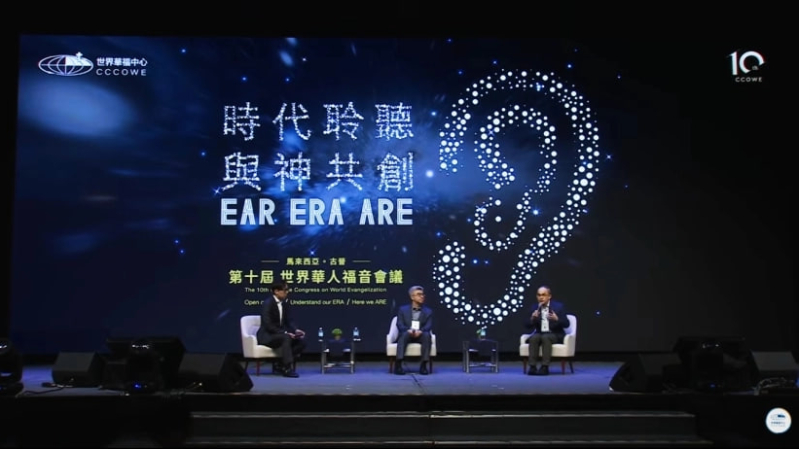
On the morning of the second day of the 10th Chinese Congress on World Evangelization (CCOWE), Rev. Wang Wei-chuan (王唯權) of CrossPoint Church moderated a dialogue and wrap-up session, inviting main speakers Rev. Clement Chia (謝木水) and Rev. Chuang Yu-ming (莊育銘) to exchange insights on the core nature of "the Gospel" and how the contemporary Church can return to its roots.
The Gospel Is God's Good News to the World
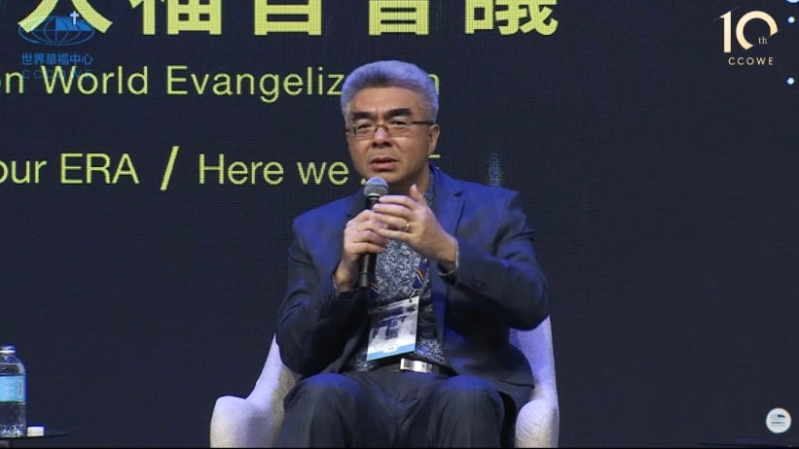
Addressing the question of "What is the Gospel?", Rev. Clement Chia, Principal of Singapore Bible College, noted that the Gospel is primarily the good news of God bestowed upon humanity, centered on the personal arrival of Jesus Christ. "At great cost, Jesus took on human form and dwelt bodily among us," Chia explained, "allowing us to see that He is full of grace and truth, opening the way to the Father's Kingdom."
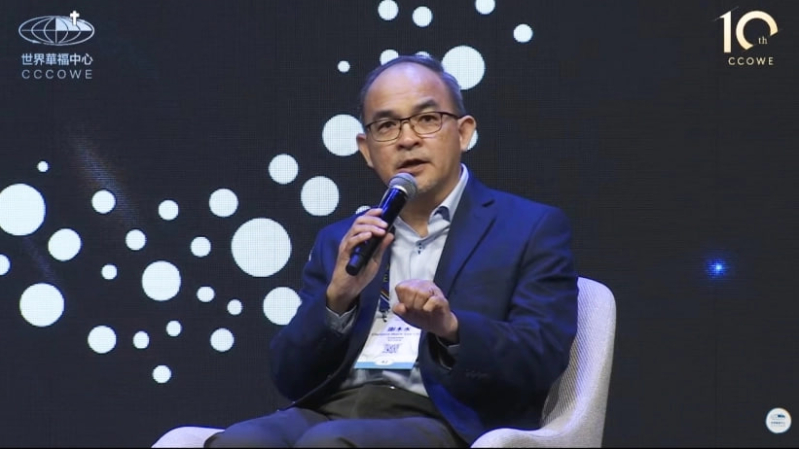
Rev. Chuang Yu-ming, Senior Pastor of Tamkang Church in Taiwan, approached the Gospel through the lens of royalty. "The Gospel means that the King we have been waiting for has finally arrived," Chuang stated. He emphasized that this King brings the promised identity of sonship, adopting believers as children of God. This means the Gospel goes beyond pardoning sin—it carries the transformative power to enable believers to live lives reflecting their status as God's children.
Chuang further pointed out that the Gospel contains a future-oriented promise: God will bestow the inheritance of all creation upon His children, enabling humanity to live on Earth according to His original design. He stressed that this promise "is not meant to be realized only in an abstract, heavenly eternity," but is to be progressively manifested within the world God created.
The Urgent Need to 'Embody' the Gospel
Discussing the "embodiment" of the Gospel, Chia observed that contemporary churches often suffer from "excarnation"—a phenomenon influenced by modern dualistic thought where believers reduce the Gospel to mere soul salvation while neglecting the body, community, and holistic life renewal.
This mindset, Chia argued, has fostered an unhealthy intellectualism within the Church, leading people to conflate information, knowledge, intelligence, and wisdom. "Believers easily assume that information equals knowledge, that knowledge equals intelligence, and that intelligence equals wisdom," Chia said. He warned that this superficial pursuit of knowledge tricks people into believing that accumulating information is synonymous with spiritual transformation, exacerbating misunderstandings of the Gospel.
Consequently, Chia called on believers to return to the physical church community and genuine interpersonal relationships: "We must return to the church site, back to face-to-face interaction, touching one another's lives, allowing others to touch our inner pain, supporting one another, and walking together in prayer."
Chuang warned believers against falling back into the behavioral legalism cautioned against in Romans 7. "Since birth, we have relied on this single habit: trying to perform good deeds to prove we are worthy of the Gospel, worthy of sonship, and worthy of the Christian label—only to fail repeatedly."
He emphasized that only Christ achieved true "Incarnation." What believers must pursue instead is allowing the Holy Spirit to tangibly reside in their lives, making the ongoing work of the Gospel visible to others as a true manifestation of Christ in them.
Returning to the Gospel: From Moralism Back to Christ the King
Turning to the messages preached in contemporary pulpits, moderator Rev. Wang Wei-chuan noted that churches sometimes drift from the orthodox Gospel, falling into the twin extremes of "moralism" or "moral licentiousness." Citing theologian Karl Barth, Chuang responded: "One of humanity's greatest problems is assuming that the Gospel is already a finished possession in our pocket."
Chuang explained that the Gospel is not a static concept, but a dynamic, ongoing call issued by a King. "From the beginning, many were never taught that the Gospel requires repentance and total commitment to the King of God's Kingdom, letting Him rule over their lives."
He urged the Church to embrace the full Gospel once again, "listening with fear and trembling to what the Gospel is still saying to us today." He pointed out that the Gospel is not merely about rescuing people from hell, but about acknowledging Christ as King, allowing Him to intervene in one's life, restore vitality, and guide believers into a higher paradigm of living.
Chuang illustrated this point using everyday analogies: "When we encourage people to marry, we don't just tell them not to commit adultery or get divorced. When we send children to school, we don't merely tell them not to cheat or break school rules. When we teach someone to drive, we don't just tell them to avoid accidents or traffic tickets."
If evangelism consists solely of telling people "don't go to hell," Chuang argued, such a message fails to address the deep existential struggles of the human heart.
Chia agreed, noting that churches today sometimes use consumerist and utilitarian "gospels" to shape believers, failing to anchor God's people in the true Gospel. "The Church's greatest shortcoming toward God today is failing to lead His people back into the Gospel to be shaped by it," Chia said, quoting Martin Luther: "The mark of the true Church is the Gospel, and nothing else."
Rediscovering the Kingdom of God
Regarding the "Kingdom of God," Chia drew from Old Testament Israelite history to argue that local churches ought to serve as a "dress rehearsal of the Kingdom." He explained that God chose Abraham and his descendants to display His divine Kingdom within history—a community keeping God's commandments, living in holiness, and set apart from the world.
Chuang returned to the Gospel preached by Jesus, emphasizing: "Christ is King, and the Gospel is the Gospel of the King." He added that there are no shortcuts to returning to the Gospel: "There is no other way than to go back and diligently read the Scriptures."
He expressed conviction that all answers are contained within the Bible. Reading Scripture requires entering its original context and engaging in active discussion with others to grasp the grand scope of the Gospel. "We must proclaim an answer that the world truly longs for in its heart—a Gospel capable of genuinely transforming human lives," Chuang encouraged.
The Christians the World Needs
In response to the concluding question—"What kind of Christian does the world need today?"—Chia stated that the world longs for "people who are deeply loved by God and know how to love." Such lives naturally demonstrate self-discipline and holiness, making universal values like love, justice, peace, and grace visible to all.
Chuang added that the world needs "Christians through whose lives the Gospel can be seen." He cautioned that this cannot be achieved through human willpower alone, but requires the Holy Spirit's work to lead believers into the power of the Cross, liberating them step-by-step from the bondage of sin.
Sharing his personal testimony, Chuang admitted: "I walked this path myself, guided hand-in-hand by God—quitting a mouth full of profanity, overcoming a two-pack-a-day habit of 40 cigarettes, turning away from pornography, and continually being led by God to put to death the misdeeds of the body. He held my hand to break my bondages to lust and sin, because the Spirit desires what is contrary to the flesh."
He concluded: "Allowing people to see the Gospel is far more persuasive than merely letting them hear the Gospel."