The latest global religious diversity research report from Pew Research Center shows that Singapore has emerged as the world’s most religiously diverse nation, while the United States ranks first in religious diversity among the world's most populous nations.
This study, part of the Global Religious Futures project, analyzed the religious composition of 201 countries and territories worldwide as of 2020. The report divides populations into seven categories—Christians, Muslims, Hindus, Buddhists, Jews, adherents of other religions, and the religiously unaffiliated—and calculates a Religious Diversity Index (RDI) score based on the evenness of representation of these groups in each country.
Singapore as Country with Highest Global Religious Diversity
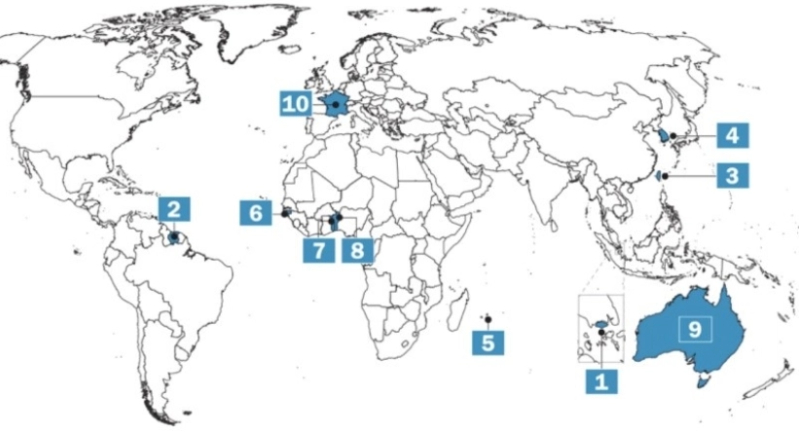
Singapore earned a score of 9.3 on the 10-point Religious Diversity Index (RDI), becoming the country with the most even distribution of the seven religious categories. Local Buddhists account for 31%, religiously unaffiliated 20%, Christians 19%, Muslims 16%, Hindus 5%, other religious adherents 9%, with no single religious group holding a majority.
Suriname ranks second and is the only Latin American country to enter the top 10. About 53% of its population identifies as Christian, alongside significant Hindu (22%), Muslim (13%), and religiously unaffiliated (8%) groups.
Other top 10 countries are mainly concentrated in the Asia-Pacific region—including Taiwan, South Korea, and Australia—and sub-Saharan Africa, including Mauritius, Guinea-Bissau, Togo, and Benin. France is the only European country entering the top 10 for religious diversity. Its population is composed of 46% Christians, 43% religiously unaffiliated individuals, and 9% Muslims.
Countries with Highest Religious Diversity Among World's Most Populous Nations
Among the world's top 10 most populous countries, the United States has the highest religious diversity, scoring 5.8. As of 2020, 64% of the U.S. population is Christian, about 30% religiously unaffiliated, the remainder being Muslims, Hindus, Buddhists, Jews, and other religious groups.
Africa's most populous Nigeria follows closely, with Christians and Muslims each accounting for over 40%, a relatively balanced religious landscape. By contrast, Pakistan with 0.8 points becomes the lowest diversity major country, 97% of population Muslim.
Most Countries Still Dominated by Single Religion
Although there are cases of religious diversity, Pew research finds that most countries still have a single religious group as majority.
Among 201 countries and territories, 194 have at least half the population belonging to the same religious category, of which 43 countries or territories have over 95% residents adhering to the same religion. These include 25 Muslim-majority countries, 17 Christian-majority countries, and one Buddhist-majority country.
The world's lowest religious diversity countries include Yemen, Afghanistan, and Somalia, where Muslim population ratio reaches 99.8% or more. Timor-Leste and Moldova also belong to low diversity countries, with populations almost entirely Christian.
Only seven countries have no single religious majority group: United Kingdom, Mauritius, South Korea, Australia, France, Côte d'Ivoire, and Singapore.
Significant Differences in Religious Diversity Across Regions
From a regional perspective, the Asia-Pacific region has the highest religious diversity, RDI index of 8.7. This region has no single religion as majority, with the largest group—the religiously unaffiliated—accounting for about one-third of the population.
North America (RDI 6.0), sub-Saharan Africa (5.9), and Europe (5.6) are classified as "high diversity" regions. In these regions, Christians form the majority of the overall population; North America and Europe's second largest group is religiously unaffiliated, sub-Saharan Africa's is Muslim.
Latin America and Caribbean region belong to "moderate diversity" (RDI 3.1), with Christianity as absolute majority, plus a smaller proportion of religiously unaffiliated.
Middle East and North Africa is the least diverse region studied, religious diversity index only 1.3, with 94% of the population Muslim. This region contains five of the world's 10 least religiously diverse countries.
Christianity Remains the World’s Most Geographically Widespread Religion
According to Pew analysis, Christians are the geographically most widely distributed religious group. Most Christians live in countries with moderate religious diversity levels, but considerable numbers also reside in highly diverse countries such as the United States, Nigeria, and Ethiopia.
Globally only 1% of the population lives in "very high" religious diversity countries; 19% live in "high diversity" societies; the majority live in "moderate diversity" environments; another 9% in 'low diversity,' and 12% in 'very low diversity' countries.
Christian Proportion Declining, Increasingly Placed in Diverse Religious Environments
Notably, from 2010 to 2020, global religious diversity overall changed little, but over twenty countries saw index changes due to Christian proportion decline and religiously unaffiliated increase. Taking the United States as example, as Christian proportion declined 14 percentage points to 64% over the decade, religiously unaffiliated numbers increased, and religious diversity rose from "moderate" to "high".
Ireland also rose from "low diversity" to "moderate diversity", its Christian majority declining 11 percentage points to 81%. By contrast, the Netherlands due to the religiously unaffiliated proportion rising to 54% and Christian proportion continuing to decline, shifted from "very high diversity" to "high diversity".
Pew researchers emphasized that religious composition changes do not always alter overall diversity levels, especially when two large religious groups exchange relative size positions.
For churches and Christian organizations, this report delineates a statistical portrait: .Christianity still holds a significant global position, but is increasingly situated within complex and diverse religious ecosystems—from highly plural city-states like Singapore, to evenly divided nations like Nigeria, and regions dominated by single religion in public life. Christians either as part of social majority groups or as members of diverse patterns all need wisdom and prudence to handle interfaith relationships.
(Source: Christian Daily International)